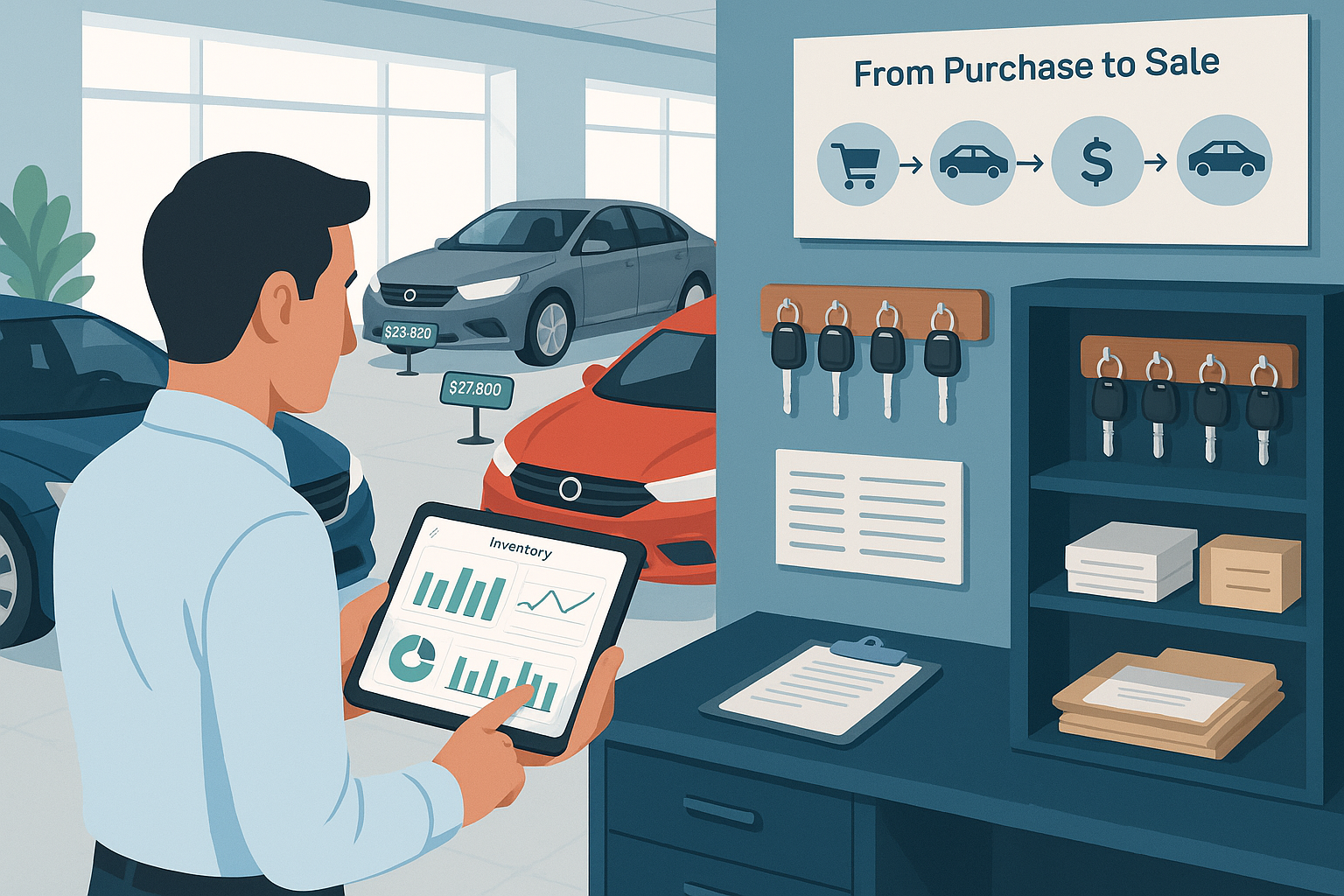
Effective stock management is the difference between a profitable dealership and one that is constantly chasing margins. Every vehicle on your forecourt represents tied-up capital, and the longer it sits unsold, the more it costs you. From the moment you acquire a vehicle to the moment it leaves your premises, every step in the process needs to be efficient, tracked and optimised.
This guide covers the complete vehicle lifecycle and the best practices that successful dealers follow to keep stock moving, margins healthy and operations running smoothly.
The Vehicle Lifecycle
Every vehicle that passes through your dealership follows a predictable path:
- Acquisition — buying at auction, taking a part-exchange, or purchasing from a private seller
- Preparation — mechanical work, MOT, cosmetic repairs, valeting and photography
- Listing — adding the vehicle to your website and advertising platforms
- Marketing — promoting the vehicle through search, social media and marketplace advertising
- Sale — enquiry handling, test drives, negotiation and invoicing
- Post-sale — finance documentation, handover and follow-up
Each stage has costs, timelines and potential bottlenecks. A good stock management system tracks the vehicle through every stage, giving you visibility into where time and money are being spent.
Acquisition: Buying the Right Stock
The foundation of good stock management is buying the right vehicles at the right price. This requires:
Market-Led Buying
Rather than buying based on gut instinct, use data to inform your purchasing decisions:
- What is selling? — analyse your own sales data and marketplace trends to identify vehicles in demand
- What margin can you achieve? — compare trade values against realistic retail prices in your area
- How quickly will it sell? — vehicles with high demand and limited supply sell faster
- What preparation will it need? — factor in reconditioning costs before agreeing a purchase price
Our dealer management system integrates with AutoTrader and CAP to provide real-time valuations, helping you make informed buying decisions at auction or when appraising part-exchanges.
Accurate Record-Keeping from Day One
When a vehicle enters your stock, every detail should be recorded immediately:
- Vehicle specifications (populated automatically via VRM lookup)
- Purchase price and seller details
- VAT status — margin scheme or qualifying vehicle
- Source — auction, part-exchange, private purchase or trade
This data forms the basis for every subsequent calculation, from reconditioning budgets to final profit figures. Starting with accurate records prevents problems downstream.
Preparation: Getting Vehicles Retail-Ready
The preparation phase is where many dealers lose margin without realising it. Common issues include:
- Vehicles sitting in preparation for too long — every day in prep is a day not on sale
- Uncontrolled reconditioning spend — costs escalating beyond what the margin can absorb
- Poor photography — reducing online engagement and enquiry rates
Controlling Preparation Costs
Track every cost against the individual vehicle in your DMS:
- Mechanical repairs and servicing
- MOT costs
- Smart repairs, paint touch-ups and alloy wheel refurbishment
- Valeting and detailing
- Photography
By recording costs per vehicle, you can see the true stand-in cost at any point. This prevents the common problem of a vehicle appearing profitable on paper but barely breaking even once all preparation costs are accounted for.
Setting a Preparation Timeline
Aim for a maximum preparation time based on your stock profile. For most independent dealers, a target of 3 to 5 working days from acquisition to being listed online is achievable. Anything longer means capital is tied up in vehicles that are not generating enquiries.
Track preparation time within your DMS and identify bottlenecks — is it waiting for parts, workshop capacity, photography or listing delays? Using task boards to manage vehicle preparation checklists ensures every step is tracked and nothing is missed.
Listing: Maximising Visibility
Once a vehicle is prepared, it needs to be visible to buyers as quickly as possible. This means listing across multiple channels simultaneously:
Your Dealer Website
Your dealer website is the hub of your online presence. Every vehicle should have a detailed listing with:
- High-quality images (multiple angles, interior and exterior)
- Accurate specifications
- Clear pricing — cash and finance where applicable
- A compelling description highlighting key features and selling points
Marketplace Advertising
Extend your reach by syndicating stock to major marketplaces:
- AutoTrader — the largest UK automotive marketplace
- eBay Motors — broad audience reach
- CarGurus — price-comparison focused buyers
- Motors.co.uk — additional marketplace exposure
Our DMS provides automated data feeds to all major platforms, ensuring your stock is listed consistently and updated in real time when prices change or vehicles sell.
Google Vehicle Ads
For maximum visibility, Google Vehicle Ads place your actual stock at the top of Google search results when buyers search for vehicles. As we covered in our Google Vehicle Ads guide, one dealer achieved 23.9k visitors, 1.66 million impressions and 350 conversions in just three months.
Pricing Strategy
Pricing is one of the biggest levers in stock management. Price too high and vehicles sit unsold, tying up capital. Price too low and you leave margin on the table.
Data-Driven Pricing
Use market data to set competitive prices:
- Retail comparison — what are identical or similar vehicles advertised at locally and nationally?
- Days in stock benchmarks — how long are comparable vehicles taking to sell?
- Margin requirements — what is the minimum acceptable return on each vehicle?
Price Adjustments
Set rules for when prices should be reviewed:
- After 14 days — review positioning against the market
- After 30 days — consider a price adjustment if enquiries are low
- After 45 days — more aggressive action may be needed to move the vehicle
- After 60 days — evaluate whether the vehicle should be traded, auctioned or significantly reduced
Tracking stock age within your DMS makes it easy to identify vehicles that need attention before they become a problem.
Social Media and Marketing
Listing vehicles is not enough — you need to actively promote them. A consistent social media presence keeps your stock in front of potential buyers:
- New stock announcements — post vehicles as soon as they are listed
- Price reductions — highlight value when prices are adjusted
- Sold posts — build social proof and demonstrate demand
- Behind-the-scenes content — preparation videos, workshop content and team introductions
Our social media automation tools allow you to post vehicles directly from the DMS to your Facebook page, saving time and ensuring consistency.
Monitoring Performance
You cannot improve what you do not measure. Key metrics every dealer should track:
Days in Stock
Average time from purchase to sale — aim for under 45 days
Gross Profit
Per-vehicle profit after all costs are deducted
Stock Turn
How many times your stock cycles through per year
Recon Costs
Average reconditioning spend as a percentage of retail price
Our dealer management system provides comprehensive reporting across all these metrics, giving you the insights you need to optimise your stock strategy.
Frequently Asked Questions
What is a good average days in stock for a car dealer?
Most successful independent dealers aim for an average of 30 to 45 days in stock. Vehicles that remain unsold beyond 60 days typically require a price adjustment or alternative disposal strategy to avoid tying up capital.
How should dealers track reconditioning costs?
Reconditioning costs should be tracked per vehicle within a dealer management system. This includes mechanical repairs, MOT work, cosmetic preparation, valeting and any other expenses incurred before the vehicle is ready for sale. Per-vehicle tracking ensures accurate profit calculations.
What is the best way to advertise dealer stock online?
The most effective approach is to list vehicles on your own dealer website alongside major marketplaces such as AutoTrader, eBay Motors, CarGurus and Motors.co.uk. Using a DMS with automated data feeds ensures your stock is syndicated consistently across all platforms.
Streamline Your Stock Management
Managing stock effectively requires the right tools, the right data and the right processes. Our dealer management system is built specifically for car dealers, providing everything you need to manage the complete vehicle lifecycle from acquisition to sale.
Get in touch with our team to see how Haswent can help you turn stock faster, control costs and improve your margins.